This eLearning is approved by the Royal Society of Biology. Training course approval is an independent review process that recognises relevant, high quality training. Upon completion of this course, attendees can claim 6 CPD points.
Who should complete this course?
This eLearning is aimed at anyone involved in the transport of infectious substances on-site or off-site, including:
- Health, safety and biosafety advisors and professionals
- Facility mangers and coordinators
- Managers (including science and operations)
- Laboratory staff
Note: The material presented in this eLearning is based primarily on universal principles, such as those outlined by the World Health Organization (WHO) and UN Modal Regulations. While this eLearning mentions specific UK and international law at different points, this is to provide examples of how some of those fundamental principles are legislated. Hence, this eLearning is open to audiences from any country or geographical location.
Disclaimer: This eLearning is intended for awareness only. It does not constitute any official or formal dangerous goods training as required by UN Modal Regulations and other national and international regulations and agreements (e.g. The International Air Transport Association (IATA) Dangerous Goods Regulations (DGR) Manual). It has not been approved or accredited by any national competent authority, such as a civil aviation authority.
Course details
- 2-hour course
- £160 ex VAT
- Internet required
- Self-directed
- Approved by The Royal Society of Biology
- 6 CPD points
Requirements and qualifications
Basic understanding of how biological laboratories are operated is recommended. This eLearning is presented in English.
Course description
Transport and transfer of infectious substances is an inherent part of any biological laboratory operations. All infectious substances must be transported and transferred in a way that reduces the likelihood of their release in order to protect the staff, other personnel, the general community, and the environment.
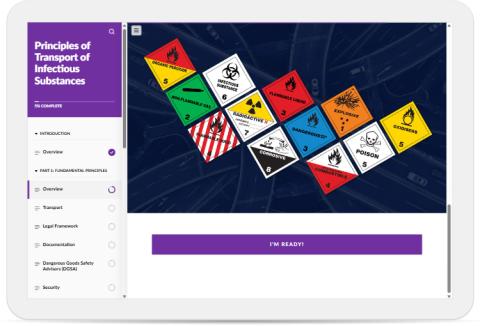
This eLearning provides fundamental requirements for the safe transport and transfer of infectious substances. It is divided into three parts:
- Fundamental Principles
- On-Site Transfers
- Off-Site Transport
Note: Contents of this eLearning are also included in the Biorisk Advisor Training: Blended learning and Biorisk Advisor Training: Facilitated learning.
Learning outcomes
You will be able to:
- Define 'infectious substances' for the purpose of transport and list common examples
- Define and outline the United Nations (UN) Model Regulations, and UN Modal Regulations on the transport of dangerous goods
- Describe and explain how overarching regulations are implemented through the International Air Transport Association (IATA) Dangerous Goods Regulations (DGR), Agreement Concerning the International Carriage of Dangerous Goods by Road (ADR) and International Maritime Dangerous Goods Code (IMDG)
- Describe key roles and responsibilities
- Describe general security requirements
- Describe fundamental process for on-site transfer and off-site transport of infectious substances
Assessment and certificate
Each part of this eLearning will end with a multiple-choice quiz with a pass mark of 70%. Upon successful completion you will receive a certificate of completion.
Please note that the knowledge of specific national legislation is not part of the learning objectives and will not be tested during the assessment.
Next steps
- Read our FAQs
- Contact Pirbright Training for more information