Explore our opportunities to work with leading experts in virology and study viral diseases affecting livestock and their potential to spread to humans. 

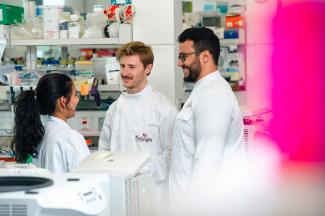
At Pirbright, our community of over 40 PhD students, affiliated with universities across the UK, benefit from access to world-class facilities in a vibrant environment that fosters research and collaboration.

We have partnered with various universities and industries to offer a selection of PhD studentships. These partnerships offer students an exceptional opportunity to obtain a broad view of infectious disease research in a dynamic and unique research environment. 

Students can work with project partners, allowing for interdisciplinary, cross-institutional approaches to solving the challenges of livestock and zoonotic viral diseases. This approach is complemented by core skills training at the student's host institutions, providing flexible training options and experiences that support a wide range of career paths.


Funding

PhD studentships for UK students are primarily funded by the UKRI Biotechnology and Biological Sciences Research Council (BBSRC).

International students are welcome to apply, but they must secure funding through scholarships or other means, as detailed in each specific studentship advert.

Available studentships

The following PhD studentships are now open for applications:

Project Title: Unravelling the Antigenic and Pathogenic Signatures of UK Reassortant Infectious Bursal Disease Virus (Ref: 2026/07)

Audrey Rolls PhD Studentship in Animal Health
 

Principal Supervisors: Dr Ahmed Ibrahim (The Pirbright Institute), Dr Kate Sutton (The Roslin Institute, University of Edinburgh)
Research Group:  Infectious Bursal Disease Virus
Anticipated Start Date: October 2026 
Programme Duration: 3.5 years (full‑time) 

This project will explore how genetic changes in the virus influence pathogenicity, antigenicity, and immune suppression. The student will generate a panel of engineered viruses using reverse genetics. These viruses will be studied in ex vivo avian immune cells and lymphoid tissue explants, with selected viruses further examined in controlled infection studies to link viral genetics with disease outcomes, that can enable development of Cell Culture Adapted Vaccines.

This project will provide the student with training in virology techniques, molecular biology, primary immune cell culture, lymphoid tissue explants, flow cytometry, and advanced imaging techniques. The project will be based at The Pirbright Institute, with joint supervision from the University of Edinburgh and collaboration with the WOAH Reference Laboratory for IBDV.

Click here for further details about the project and the application process.

Application Closing Date: 15 April 2026

Applications for the following three PhD studentships should be submitted via the University of Glasgow.

Project Title: Mechanisms of Wolbachia restriction of arboviral replication in Aedes aegypti
 

Supervisors: Dr Kevin Maringer, Dr Vikas Kumar (The Pirbright Institute); Prof S Sinkins, Dr Stephanie Rainey (The University of Glasgow) 

Arthropod-borne viruses (arboviruses) are increasing in global significance due to climate change and urbanisation. The most important vector of human arboviruses is the urban mosquito Aedes aegypti, which transmits dengue, Zika, yellow fever and chikungunya viruses. There are no antiviral therapies and reducing human cases relies mostly on vector-control. However, mosquitoes are evolving resistance to the historic use of insecticides, and therefore novel approaches for controlling arboviral transmission are needed.

Click here for further details about the project and the application process.

Note: Applications must be submitted via the University of Glasgow. The closing date is 8 May 2026.

Project Title: Vector-imposed constraints on the evolution and diversity of bluetongue virus
 

Supervisors: Dr Marc Guimera Busquets, Dr Christopher Sanders, Dr Naomi Forrester-Soto (The Pirbright Institute); Dr Joseph Hughes, Dr Paul Johnson (The University of Glasgow) 

This project offers an exciting opportunity to explore the intricate dynamics of virus-vector interactions and evolution, while developing a broad skill set that will prepare you for a successful career in science. You will work with bluetongue virus (BTV), an important insect-borne pathogen that can cause severe disease in livestock and wild ruminants. The UK and Europe are currently experiencing outbreaks of multiple strains of BTV. BTV is a segmented RNA virus, and co-infection of the same mammalian-host or insect-vector by two or more strains of BTV, may lead to the emergence of new viral strains with unknown clinical and transmission characteristics, mainly by the mechanism of genome-segment exchange or reassortment.

Click here for further details about the project and the application process.

Note: Applications must be submitted via the University of Glasgow. The closing date is 8 May 2026.

Project Title: Visualising avian influenza virus tropism and co-infection in avian hosts
 

Supervisors: Dr Thomas Peacock, Dr Helena Maier (The Pirbright Institute); Dr E Hutchinson, Dr Ed Roberts (The University of Glasgow) 

Avian influenza viruses (AIVs) are major pathogens of wild birds and farmed poultry and among the most likely causes of future pandemics in humans. In this PhD project, you will advance our understanding of the threat posed by AIVs by studying how the viruses evolve within their avian hosts. You will explore how the accumulation of mutations allows AIVs to move from infecting the gastrointestinal tract to infecting the respiratory tract, a common change in infected poultry with major implications for viral transmission and pathogenesis. You will also study how the processes of coinfection and reassortment – a form of genetic exchange between influenza viruses which greatly accelerates the emergence of new strains – develop within the infected host. Your work will combine molecular virology methods with advanced light microscopy. You will genetically engineer AIVs to encode fluorescent reporter genes, carry out infection studies in vitro and in vivo, and use advanced microscopy methods including lightsheet microscopy to study the changing behaviour of AIVs as infections develop. Your work will advance our fundamental understanding of infection biology in a way that is relevant for risk assessment and control of a serious pathogen.

Click here for further details about the project and the application process.

Note: Applications must be submitted via the University of Glasgow. The closing date is 8 May 2026.